

No products in the cart.
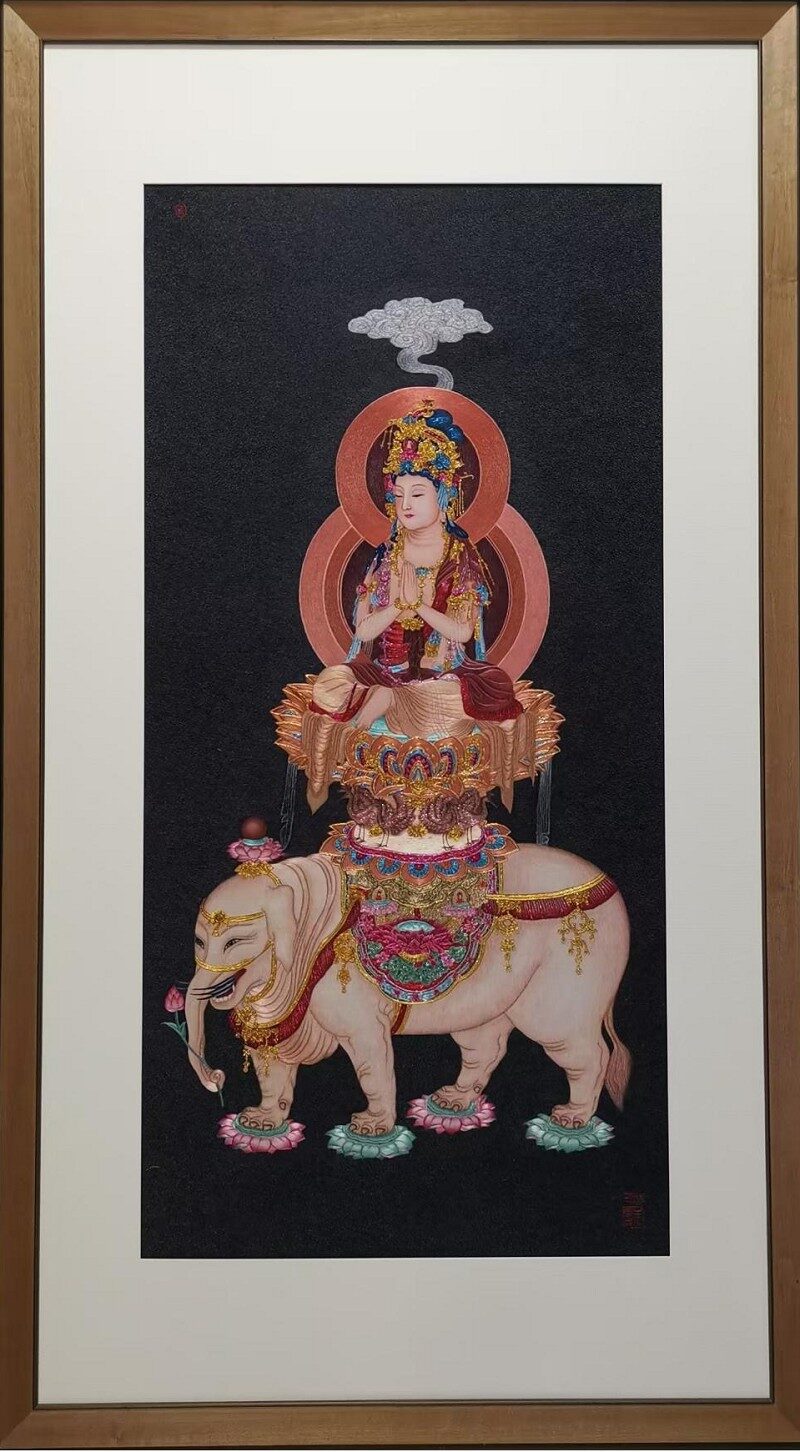
Standard configuration: Anti-reflective glass Tulip Tree solid wood frame
Product Information
- Embroidery Fabric: Real silk fabric / simulated silk fabric (non-elastic, suitable for expressing this work).
- Embroidery Thread: Real silk, plant-dyed.
- Craftsmanship: Yiran Embroidery Method, purely handmade.
- Thread Diameter: 1/4 thread – 1/16 thread.
- Stitch Density: ≥120 stitches per square centimeter.
Color Layers: Main body superimposed colors ≥5 layers.
Frame: Tulip Tree solid wood (imported American wood), front width 5.4cm, hidden mortise-and-tenon structure; the frame can also be exclusively nailed according to your needs; the frame is handmade, and actual condition may differ slightly from the illustrated effect.
Backboard: Solid camphor wood, universal, thickness 0.9cm; fixing method: recessed stainless steel screws.
Mat Board: Real silk damask fabric, padded mat board, heat-pressed and formed; or paper mat board, to meet the matching effect.
Glass:Anti-reflective glass, with light transmittance and UV protection both at 98%.
Packaging Box: Standard is a specific paper box; optional aluminum alloy case (not applicable in some countries/regions such as the United States)
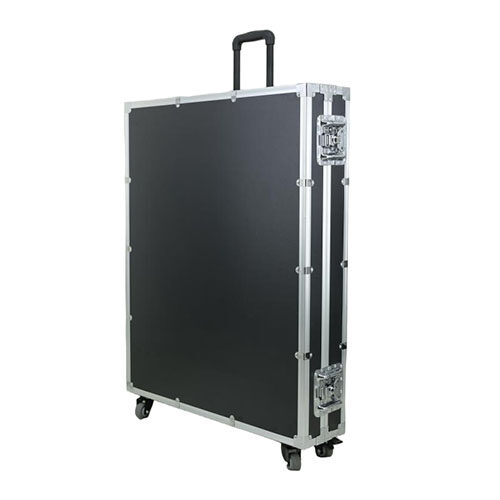 Aluminum Alloy Wheeled Trolley Case | 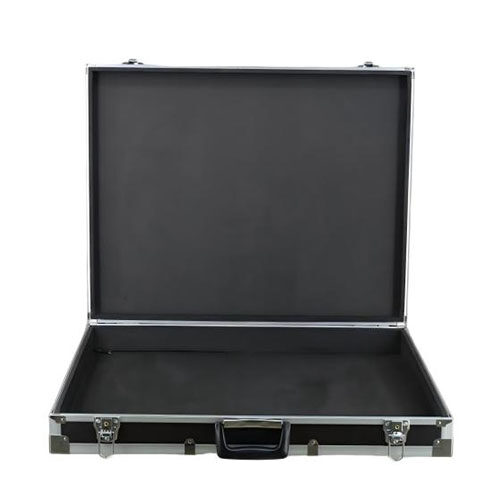 Interior Effect Lined with Black Pearl Cotton |
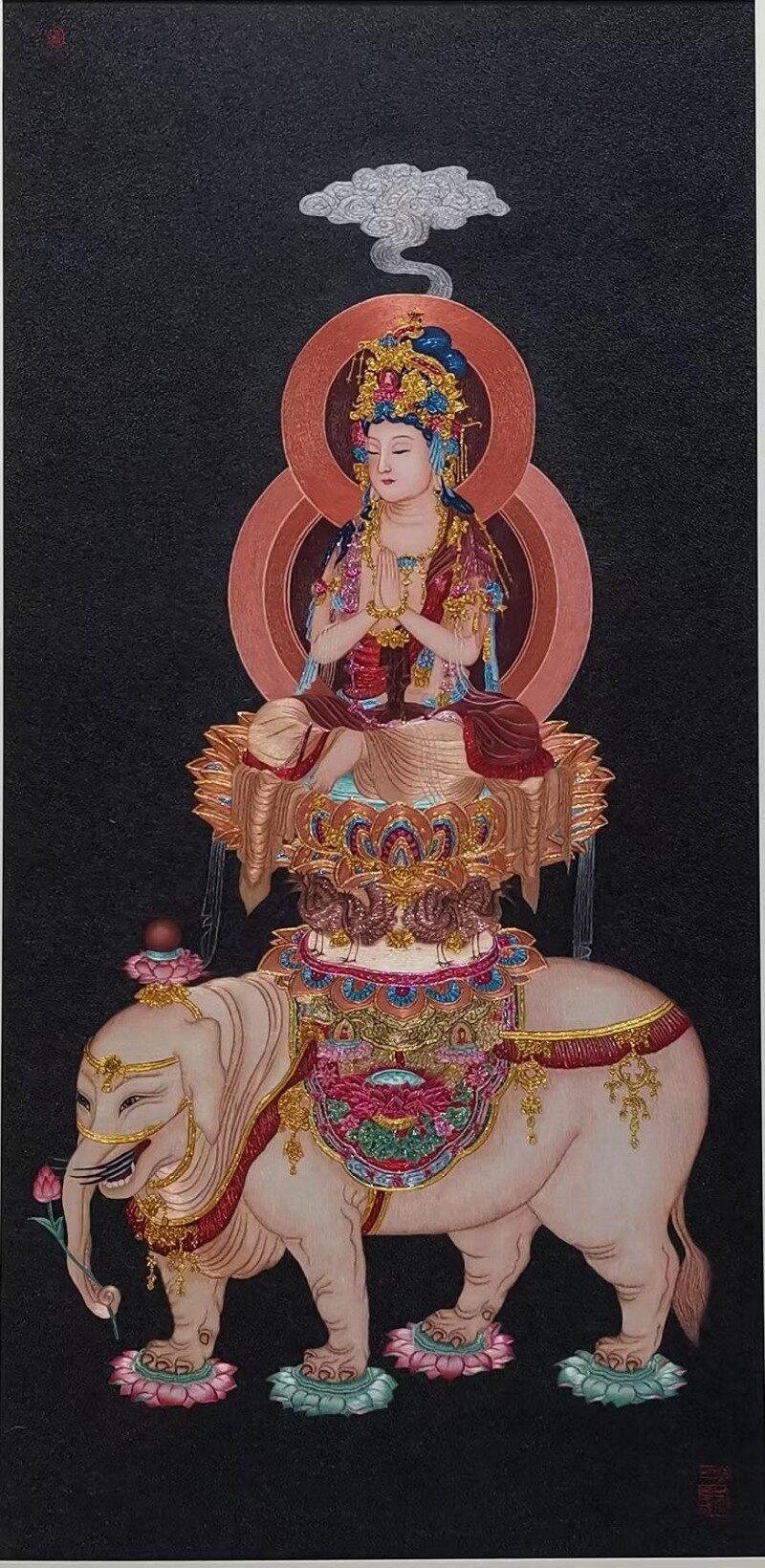
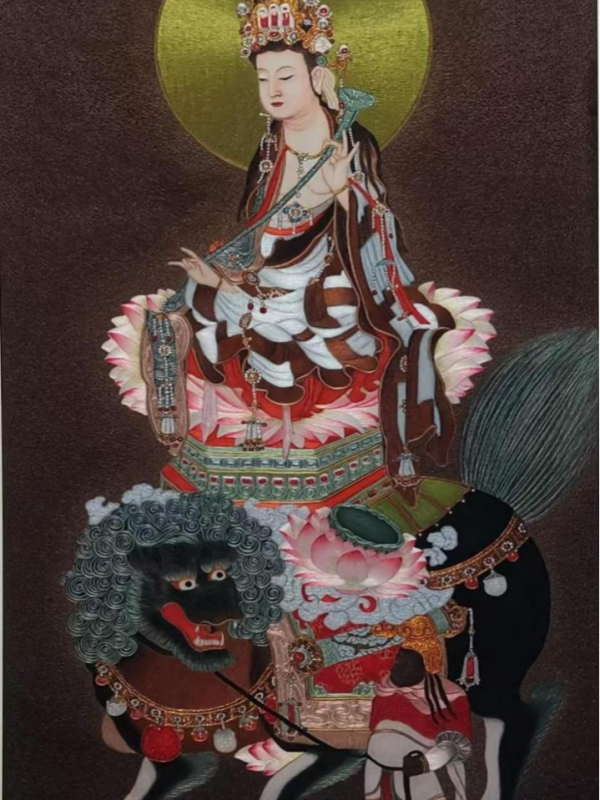
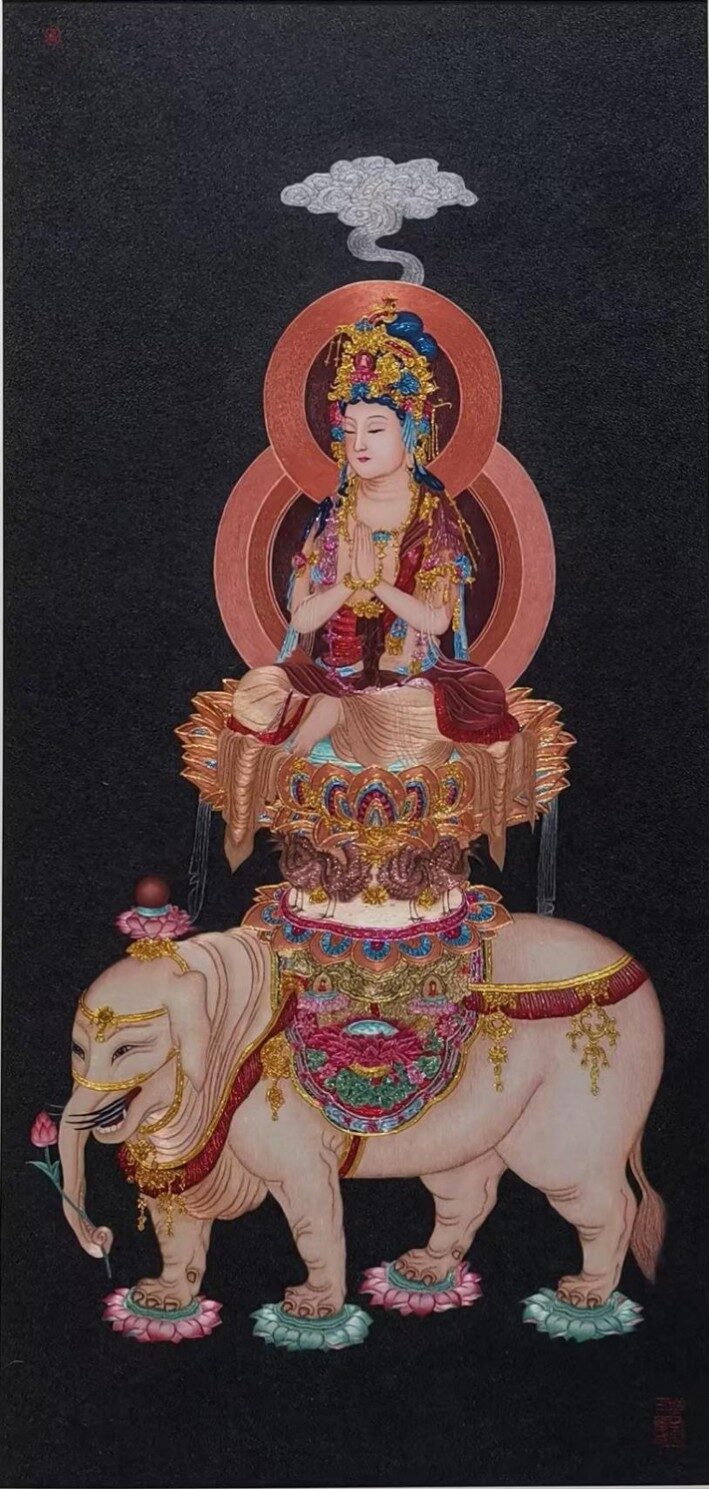
“Samantabhadra Riding the Elephant” Size: 50x100cm
Embroidered by National-Level Master Zhu Juncheng Studio Yiran Embroidery Method
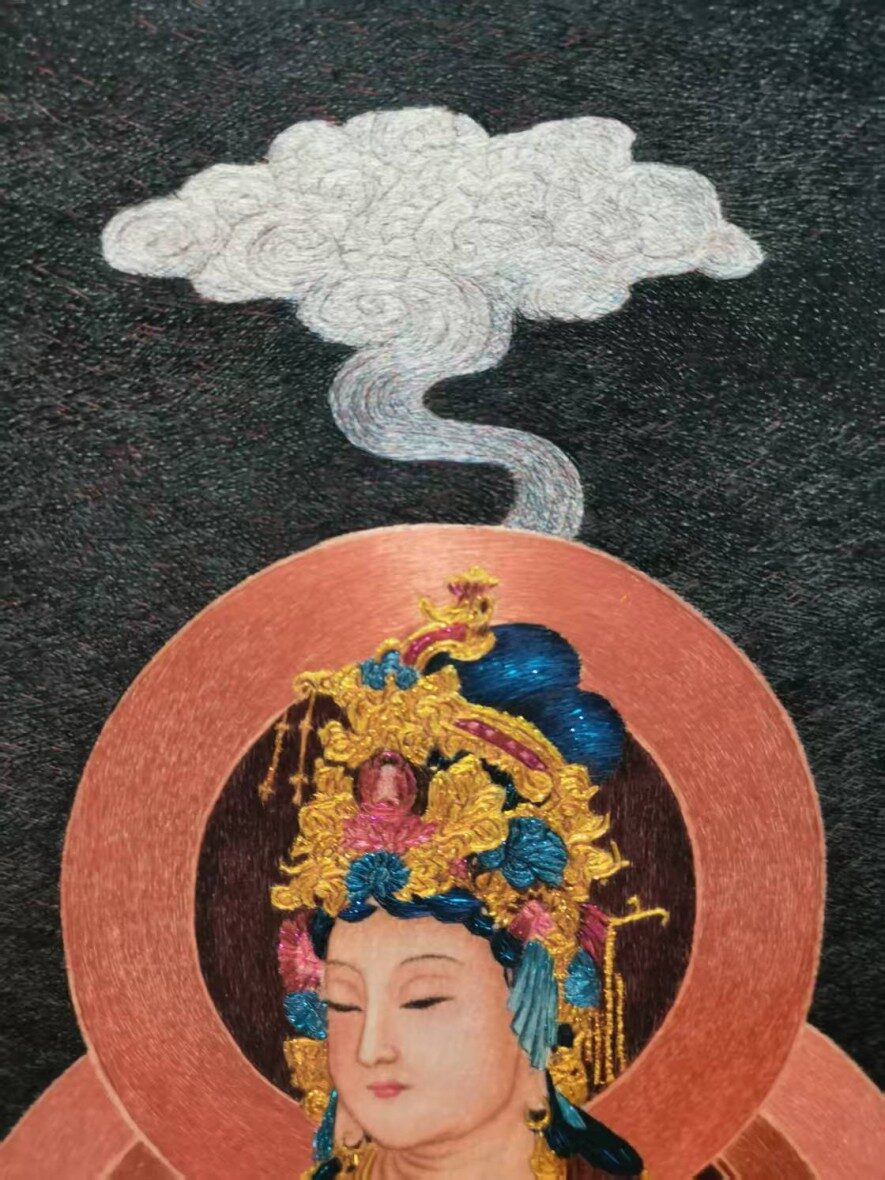
“Guanyin Riding the Elephant” Detail
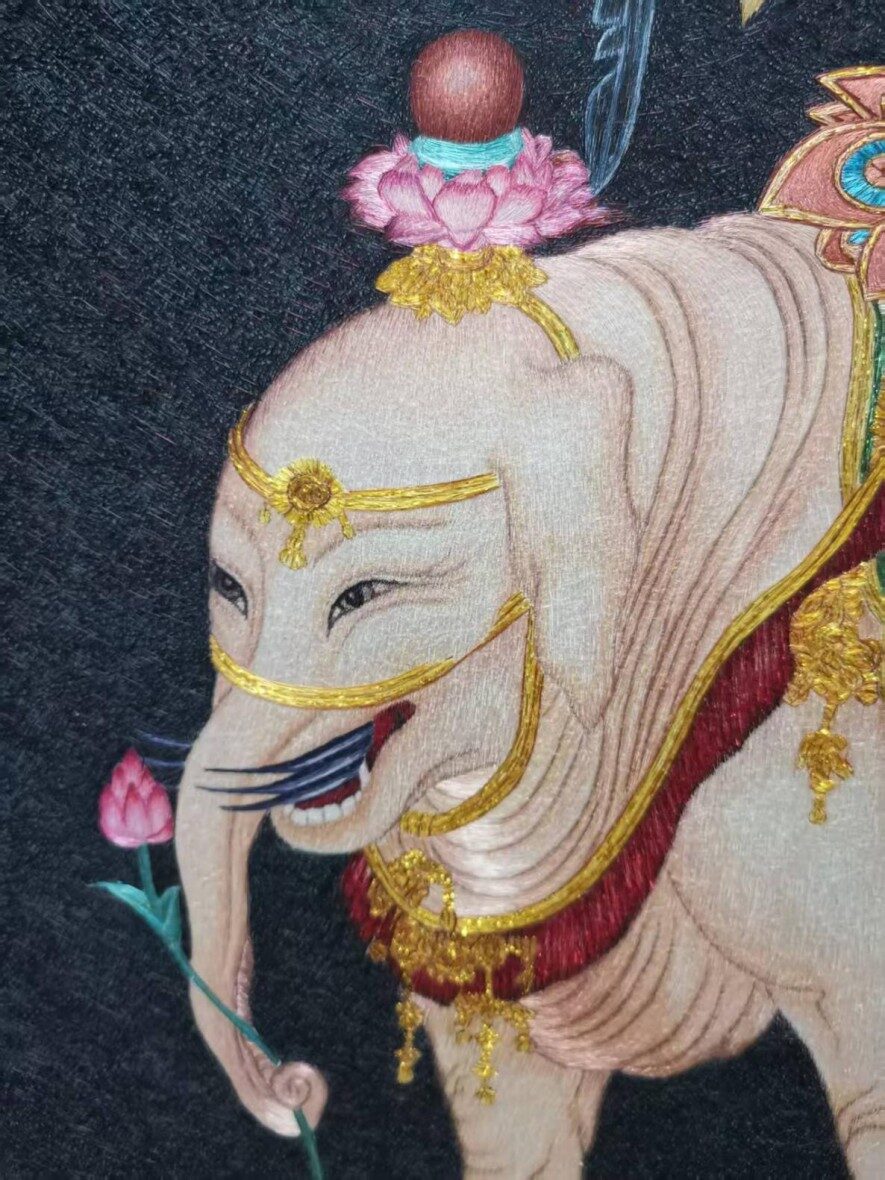
“Samantabhadra Riding the Elephant” Detail
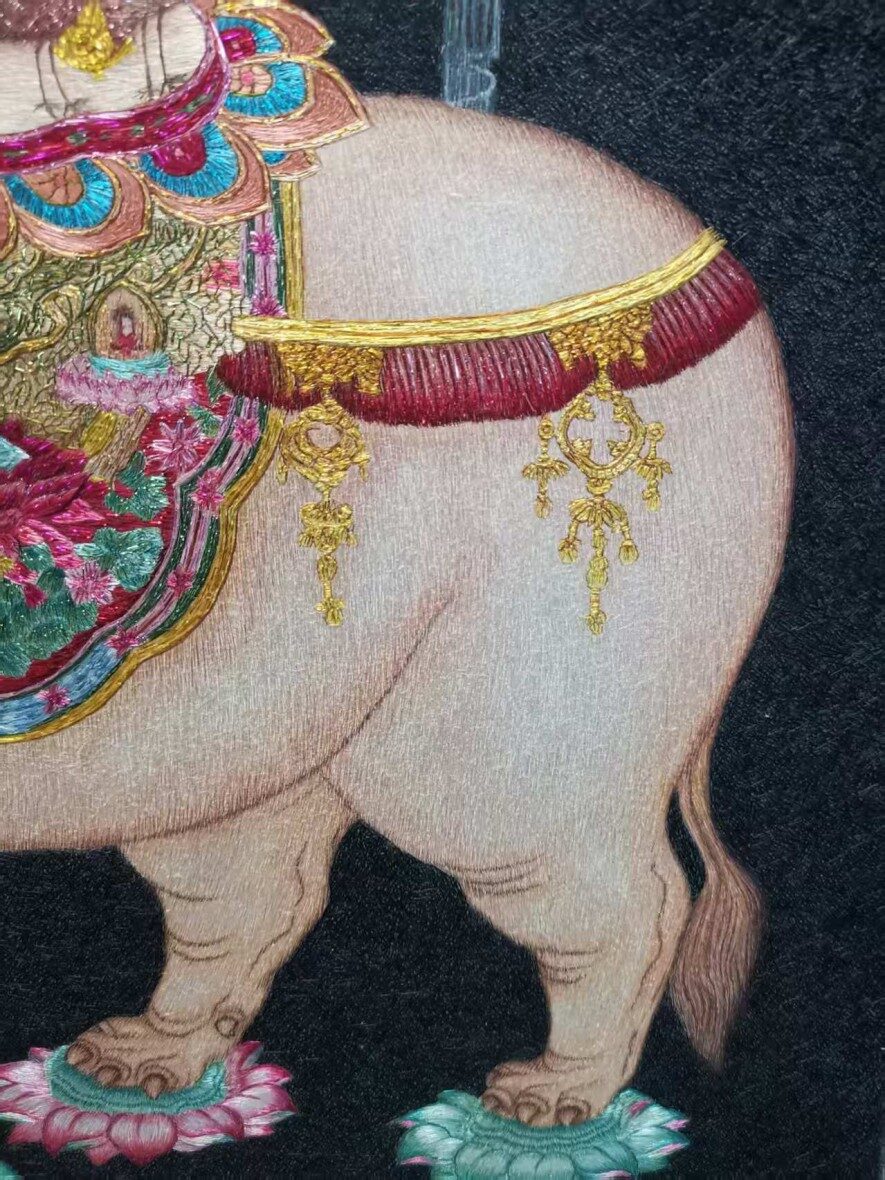
“Guanyin Riding the Elephant” Detail
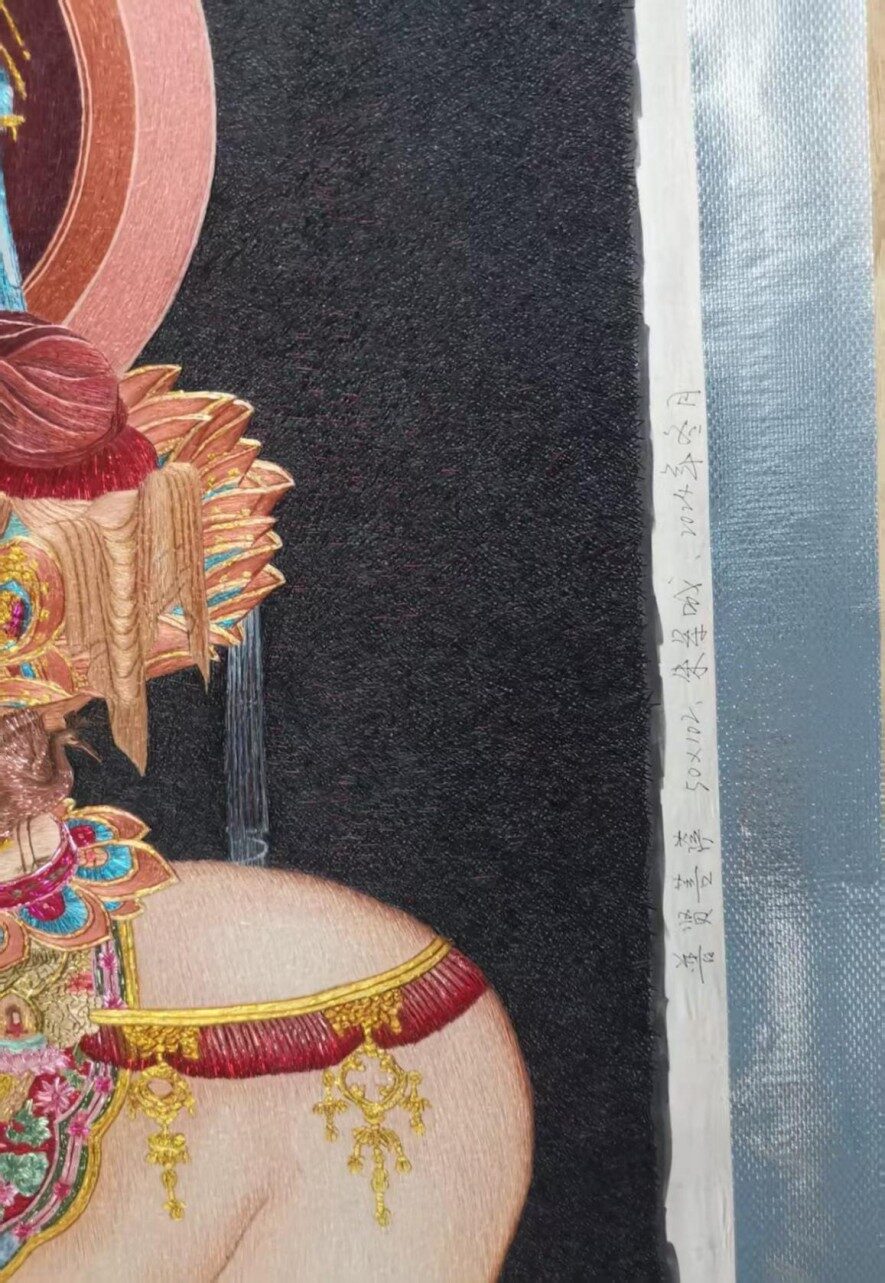
Concealed: Master Zhu Juncheng’s Handwritten Signature
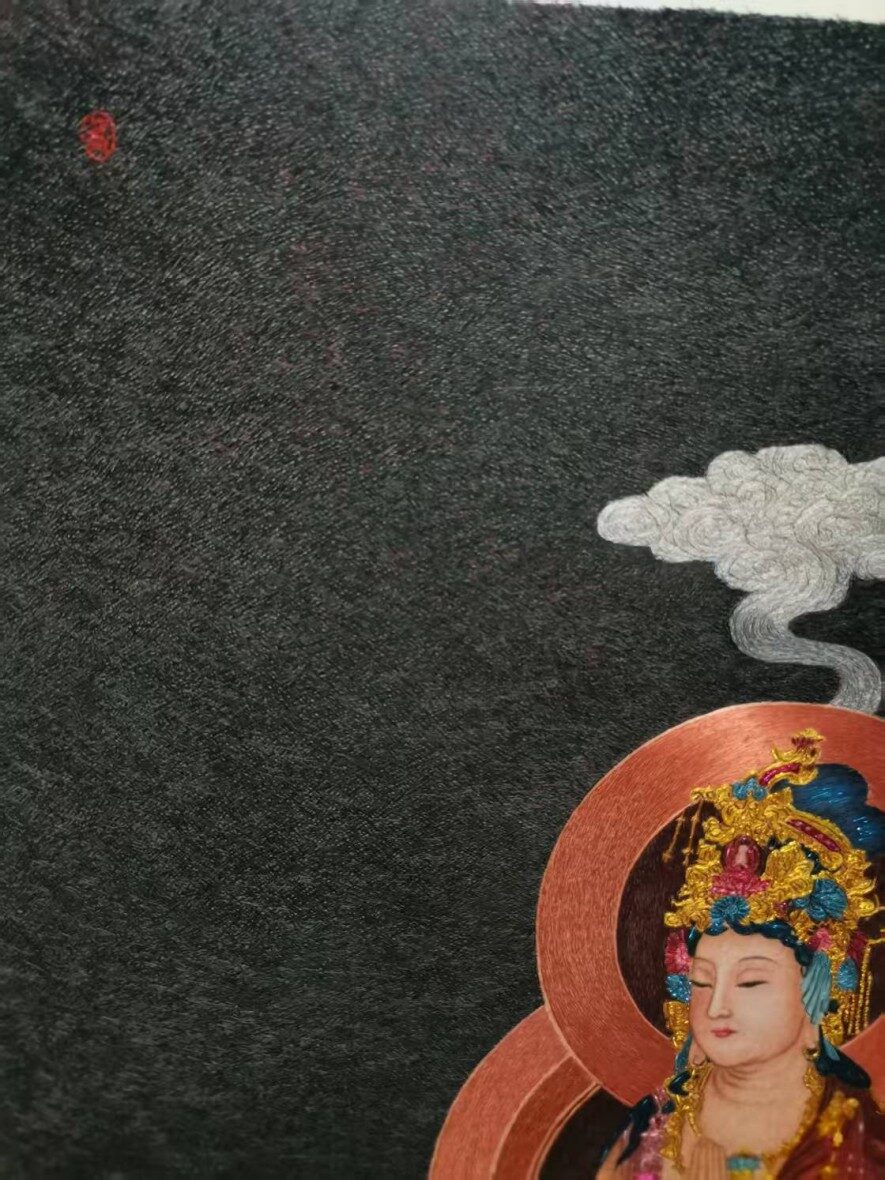
“藏” (Concealed) Character Embroidery Seal
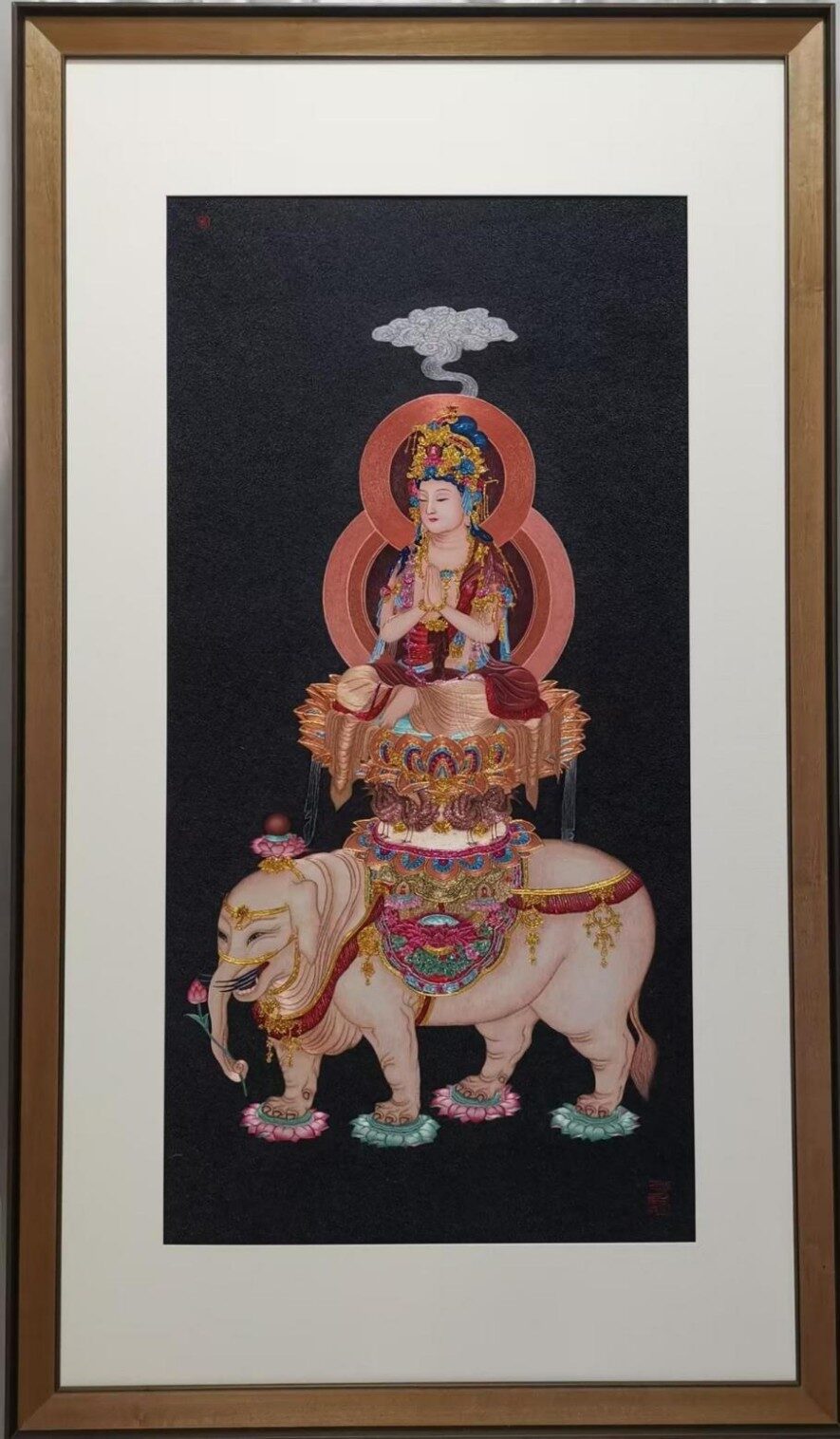
“Samantabhadra Riding the Elephant” Size: 50x100cm
Embroidered by National-Level Master Zhu Juncheng Studio Yiran Embroidery Method
“Samantabhadra Riding the Elephant” Embroidery Creation Notes
Manjushri governs wisdom, Samantabhadra governs practice; the two appear as a pair, a symmetrical paradigm of Mahayana art lasting a thousand years. Compared with Manjushri’s sharp breaking of delusion, the “six perfections and ten thousand practices” carried by Samantabhadra’s six-tusked white elephant is closer to the daily life practice of ordinary people, and is also the spiritual core most difficult to externalize in this creation. Wisdom is easy to obtain; enduring practice is the hardest. How to interpret down-to-earth vow-power with silent silk threads, how to reveal inner Buddha-nature through concrete Dharma forms, how to follow the ancients without becoming rigid and innovate without departing from the source—these were the core of our thinking throughout.
In the draft research phase, we extensively reviewed Tang and Song Samantabhadra transformation murals and Southern Song silk Buddhist banners that crossed eastward to Japan, identifying the classic format of the six-tusked white elephant and the Bodhisattva with downcast eyes holding a lotus. Research takes historical materials alone as the standard, not arbitrarily altering ancient sage rituals, simply because Dharma forms are the bridge guiding beings to clarify the mind; without source basis, the embroidery is only a stack of techniques, reduced to empty technical embroidery. Two types of misunderstandings on the market are both unacceptable: one completely copies the broken appearance of ancient paintings, falling into unthinking antiquarianism; the other arbitrarily changes statue formats, pursuing novelty and losing orthodoxy. We take the middle path: the skeletal form strictly observes ancient rules, while visual expression uses the Yiran Embroidery Method for contemporary innovation, thus achieving the wonder of balance. Most replica works on the market simplify the white elephant’s posture,削去 the six tusks, weakening the elephant’s heavy and steady sense of volume, retaining only a thin decorative image and losing the image’s original symbolic language. For this reason, we strictly refer to the proportions of the white elephant in Dunhuang murals, lengthening the torso and strengthening the heavy musculature of the limbs; the six tusks are embroidered in layers with gradient silver-white silk threads, distinguishing light and dark transitions, highlighting the white elephant’s temperament of endurance and bearing weight.
The Yiran Embroidery Method differs from the flat expression of traditional flat embroidery; it is a contemporary creation based on the evolution of thousand-year ancient embroidery stitching, skilled at using multi-layer stitches to create a warm and heavy texture. Samantabhadra’s robes are layered and complex; the Tang dynasty Bodhisattva’s celestial garments and ribbons are long and flowing. If only ancient single-direction flat stitching were used, the picture would be flat without layering—the drawback of rigidly adhering to ancient methods; the master designed forward and reverse interwoven virtual-solid stitches, giving the red-brown fabric its own textile texture, with necklaces and ribbons naturally falling with the posture, and in the flow of light and shadow, the garment seems to float with a gentle breeze, dissolving the inherent stiffness of silk threads. At the Bodhisattva’s palms joined together, the silk thread arrangement is restrained and soft, conveying a state of humility and vow-holding, perfectly complementing the open aura of the blue lion Manjushri. The entire picture is full in form and substance, yet deliberately retains virtual-solid layering; the embroidery appears real yet not real—the six-tusked white elephant, necklaces, and jeweled crowns are all illusory manifestations of dependent origination; only through external forms can one glimpse the equal, non-dual pure Buddha-nature of all beings.
The process of embroidery creation is itself a miniature practice of the ten great vows of Samantabhadra. A complete sacred image, with hundreds of thousands of stitches allowing no omission, requires sitting quietly at the desk for a fixed period each day, repeating threading, stitching, and layered coloring, combating restlessness and laziness—precisely corresponding to the virtue of “diligence.” Unlike painting, which can take shape in a short time, embroidery requires long-term persistence; under slow work, the creator can empathize with Samantabhadra’s spirit of persistent great practice. During creation, one contemplates the Bodhisattva’s Dharma form daily, yet does not cling to the sculpted or painted external appearance, constantly introspecting and realizing the essence of “seeing forms without abiding in forms,” gradually clarifying the mind and seeing one’s nature through needle and thread. This precipitation is a warmth that printed matter and assembly-line embroidery can never replicate; assembly lines seek only formal resemblance, while mind-nature embroidery focuses on observing the mind through forms.
Looking back at the thousand-year history of embroidery collections, the National Palace Museum in Taipei’s successive dynasties of Buddhist embroidery all preserve Samantabhadra and Manjushri as a pair, regarded as a complete carrier of practice. Wisdom and practice are inseparable; a single image obtains only half the Dharma meaning, and only a complete set reveals completeness. We use silk art to restore this ancient paradigm that spread across Asia and Europe, upholding ancient sage statue rituals and integrating contemporary original stitching, intending to break the shallow understanding of embroidery: it is not a home decoration ornament, but an artistic carrier that continues temple offering and inspires Buddha-mind. In ancient times, aristocratic families offered embroidered scrolls in Buddhist halls; today, people collect this Samantabhadra sacred image, observing the white elephant bearing weight, knowing that all things value practice, and seeing in tangible Dharma forms one’s own true Buddha-nature of enduring goodness.
The six tusks symbolize the six perfections, the white elephant symbolizes perseverance; thousands of threads interweave layer by layer, like ordinary people moving forward step by step. Not blindly following the old appearance of ancient paintings, not chasing vulgar new styles, taking ancient methods as the root and new stitches as branches, silk threads are silent, not deliberately depicting perfect illusions, using a scene of seeming reality yet not reality to guide viewers through external forms directly to the original mind—this is the unique, heart-reaching power of mind-nature embroidery.
Textual Research on Classics (Researched and compiled by Beijing Xiuzhentang)
“Samantabhadra Riding the Elephant”
This product is a restored embroidery work of the great practice Samantabhadra six-tusked white elephant format, paired with Manjushri and finalized in the Tang dynasty.
Origin and Dissemination in Four Phases
- Early Tang Chang’an · Establishment of the Symmetrical Paradigm
Yin Lin’s Buddhist painting system simultaneously created paired Manjushri and Samantabhadra statues, one lion and one elephant, one wisdom and one practice; “The Famous Paintings of Successive Dynasties” records the paired offering regulations, becoming the unchanging standard for later generations.
- High Tang Dunhuang · Standardization of the Image
The Manjushri and Samantabhadra transformation murals in various Mogao caves uniformly use the six-tusked white elephant format; the six tusks correspond to the six perfections and ten thousand practices, and murals and contemporaneous embroidered Buddhist banners strictly follow this symbolic setting, verifiable in the Dunhuang Academy’s complete cave catalog.
- Five Dynasties and Two Song · Popularization at Mount Emei and Mass Eastward Transmission
Mount Emei in Sichuan is the sacred site of Samantabhadra; Two Song temples produced large numbers of Samantabhadra white elephant offering scrolls; merchant ships and Dharma-seeking monks carried paired Manjushri and Samantabhadra silk paintings and embroidery samples from Mingzhou to sea, transmitting them to Heian-kyo temples.
- Kamakura Period · Complete Inheritance of Paired Statues
Southern Song eminent monks crossing eastward brought Huayan paired Bodhisattva images; Japanese Buddhist masters completely preserved the complete composition of “blue lion Manjushri + six-tusked white elephant Samantabhadra”; the paired Buddhist scrolls of Kamakura Kencho-ji and Nara Museum collections all follow the Tang-style prototype, with only slight adjustments to line softness.
Complete Chronological Vein
Early Tang Chang’an paired statue draft → High Tang Dunhuang cave standardization → Two Song Mount Emei and nationwide temple popularization of embroidery → Tang and Song complete sets transmitted eastward to Japan → Kamakura temple paired collection and replication
The complete image system of the wisdom-practice dual venerables originates entirely from the Central Plains; overseas remains are merely replicated extensions of Central Plains Tang art.
Supplementary Collection Narrative
Samantabhadra statues on the market often simplify the white elephant’s six tusks and split the paired Manjushri-Samantabhadra arrangement, losing the complete Dharma meaning of “unity of wisdom and practice”; this work strictly restores the Tang dynasty complete paired format, with triple historical mutual verification from scriptures, cave remains, and Japanese paired ancient paintings. Zhu Juncheng’s Yiran embroidery scrupulously observes the symbolic connotation of ancient statues, with innovative stitching restoring the white elephant’s heavy and warm spirit; orthodox replica embroideries in complete pairs are scarce on the market.
Exclusive Research Materials
- Ancient texts: “Avatamsaka Sutra,” “Mount Emei Gazetteer,” Kamakura temple ancient offering account books
- Domestic archaeology: Complete Dunhuang Samantabhadra transformation murals, Two Song Mount Emei cave statue catalog, Song dynasty temple embroidery remains archives
- Japanese remains: Kamakura Kencho-ji paired Manjushri-Samantabhadra ancient scrolls, Nara National Museum paired Bodhisattva silk painting permanent exhibition
- Academic support: Huayan art special research, Tang and Song Shu region Buddhist statue archaeology monographs