

No products in the cart.
Product Information
- Embroidery Fabric: Real silk fabric; or simulated silk fabric, non-elastic, to suit the expression of this work.
- Embroidery Thread: Real silk, plant-dyed.
- Craftsmanship: Yiran Embroidery Method, purely handmade.
- Thread Diameter: 1/4 thread – 1/16 thread.
- Stitch Density: ≥120 stitches per square centimeter.
Color Layers: Main body superimposed colors ≥5 layers.
Frame: Standard is Tulip Tree solid wood (imported American wood), front width 5.4cm, hidden mortise-and-tenon structure; handmade, actual condition may differ slightly from the illustrated effect.
Backboard: Solid camphor wood, universal, thickness 0.9cm; fixing method: recessed stainless steel screws.
Mat Board: Real silk damask fabric, padded mat board, heat-pressed and formed; or paper mat board, to meet the matching effect.
Glass: Anti-reflective glass, with light transmittance and UV protection both at 98%.
Packaging Box: Standard is a specific paper box; optional aluminum alloy flight case (not applicable in some countries/regions such as the United States).
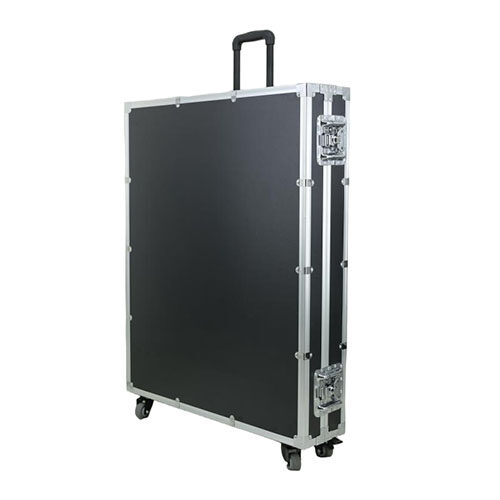 Aluminum Alloy Wheeled Trolley Case | 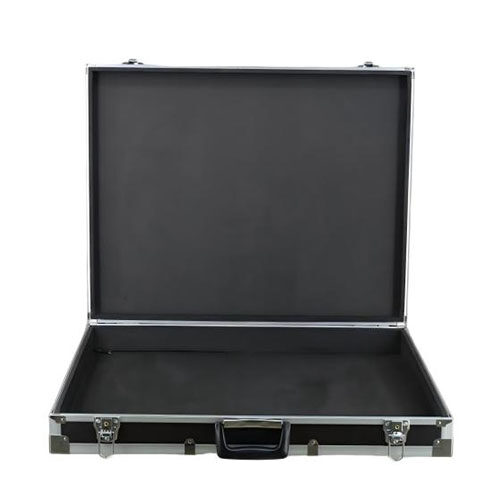 Interior Effect Lined with Black Pearl Cotton |
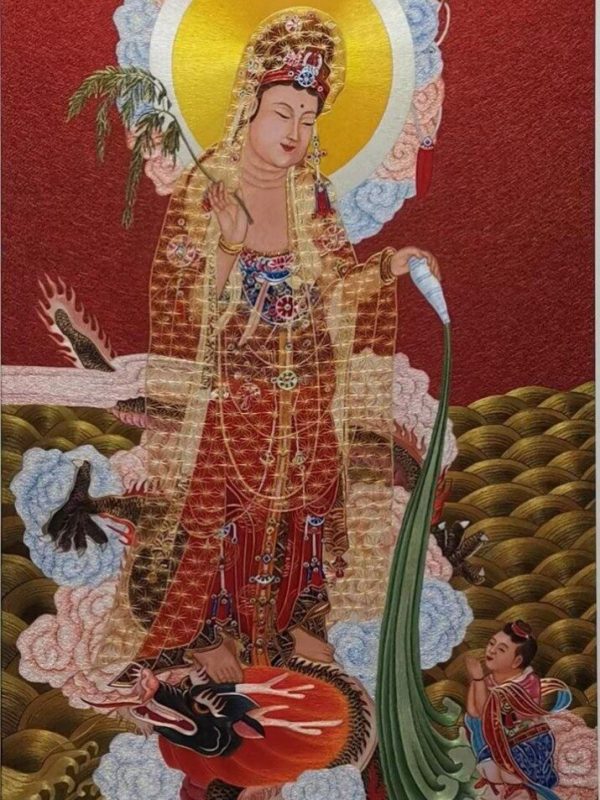
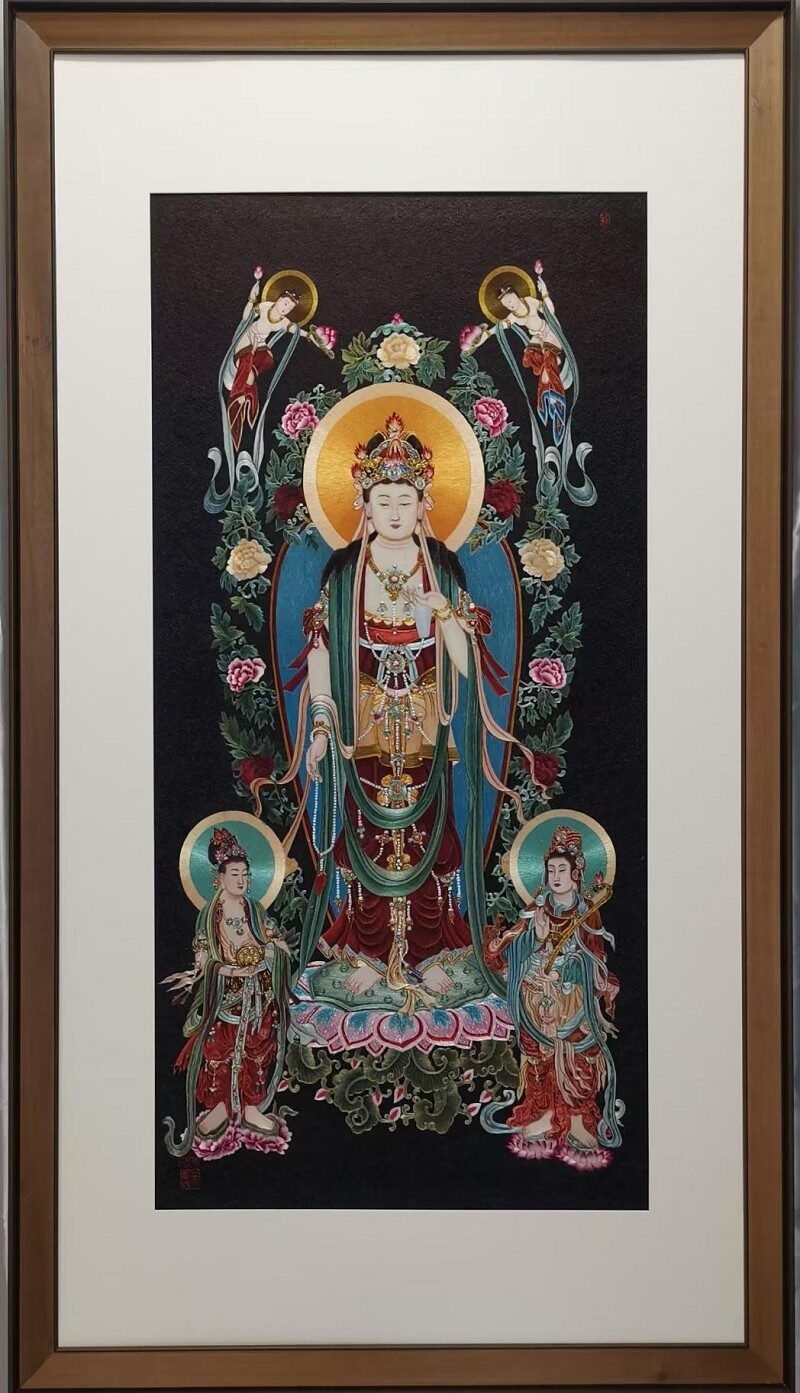
“Lotus Pedestal Guanyin with Heavenly Offerings” Size: 50x100cm
Embroidered by National-Level Master Zhu Juncheng Studio Yiran Embroidery Method
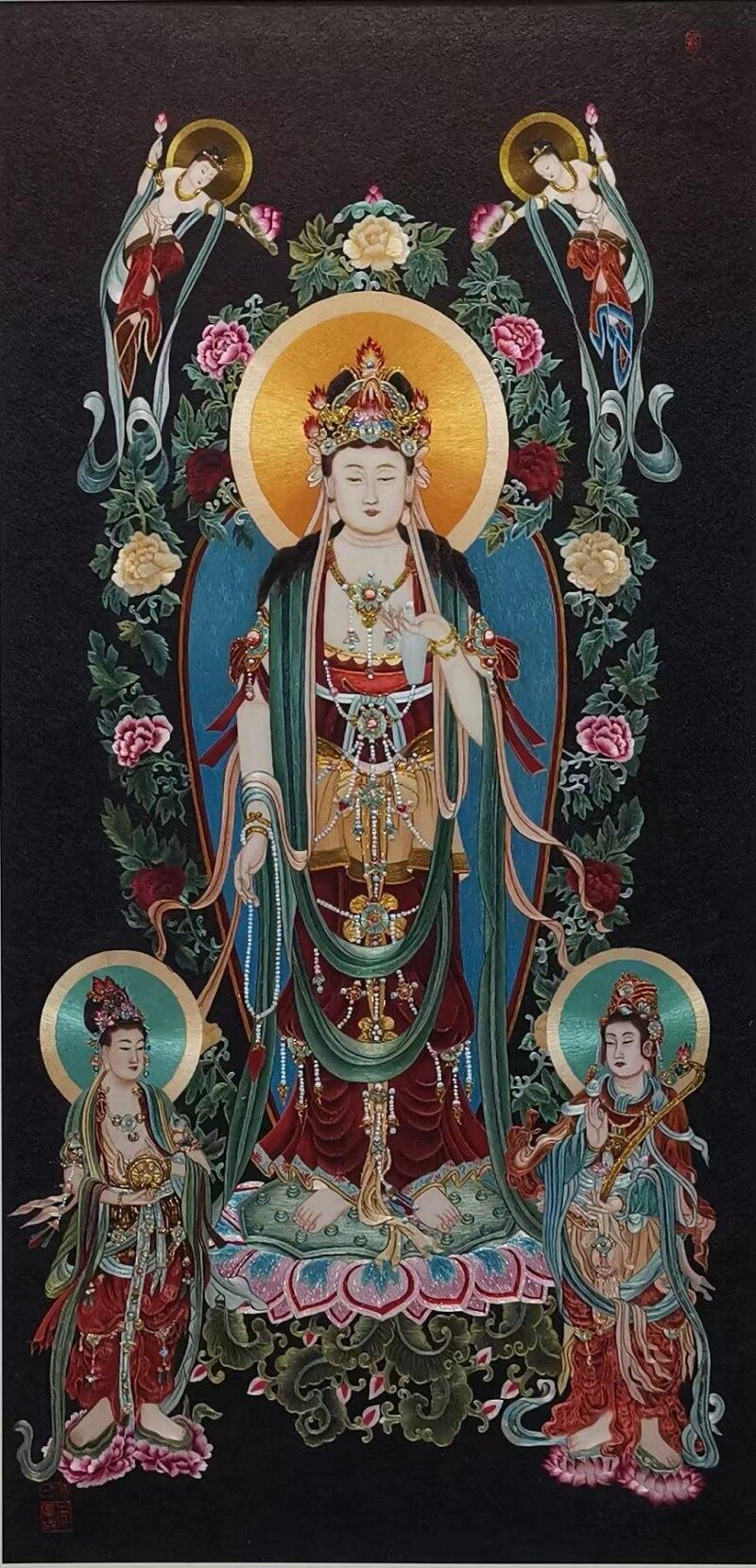
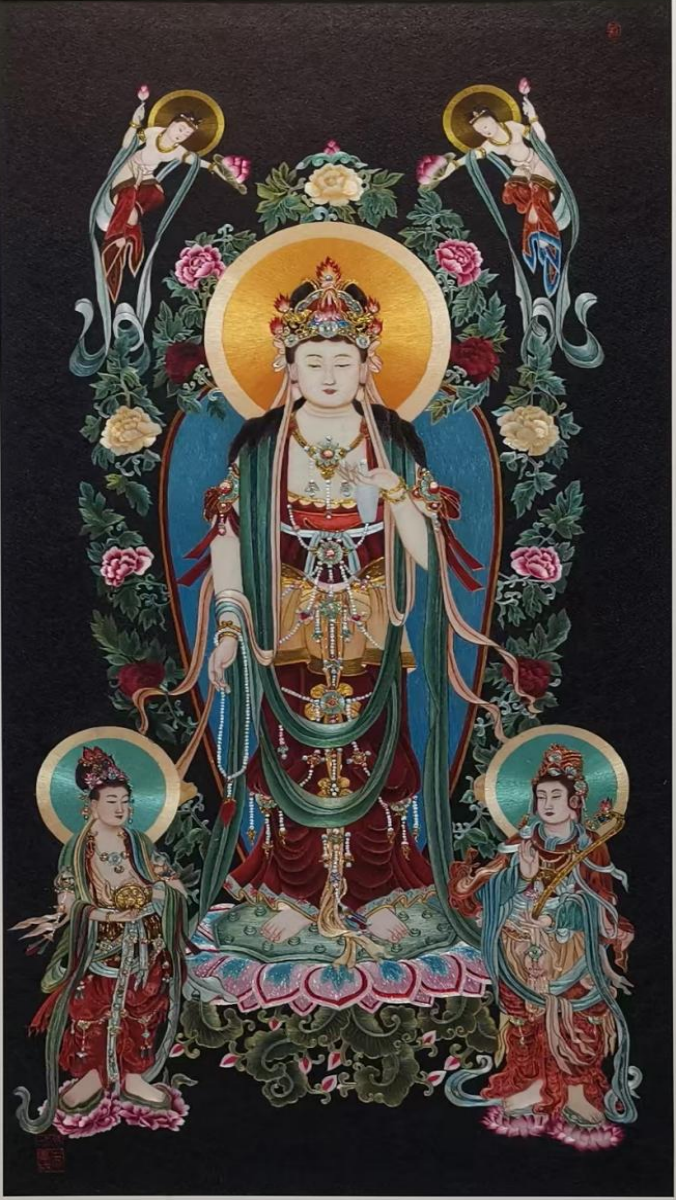
“Lotus Pedestal Guanyin with Heavenly Offerings” Detail
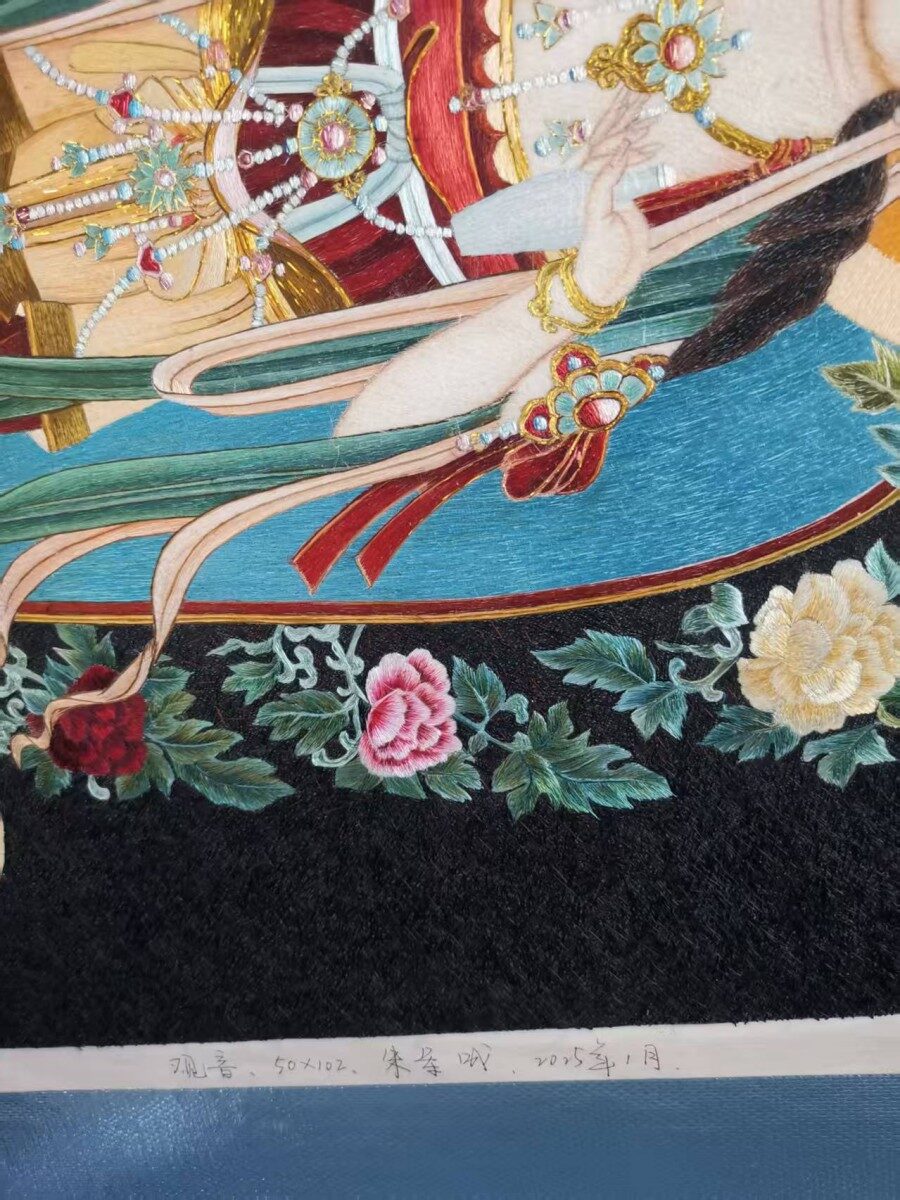
Master Zhu Juncheng’s Handwritten Signature
Embroidered by National-Level Master Zhu Juncheng Studio Yiran Embroidery Method
“Lotus Pedestal Guanyin with Heavenly Offerings” Creation Notes
Among the four sacred images, this one has the most complex composition, integrating the central Guanyin, the heavenly beings of the ten directions, and auspicious birds and clouds into one, completely reproducing the solemn scene of Dharma-protecting and offering Bodhisattvas in the Dharma realm. It is also the work that best demonstrates the balance of “revering the ancients while innovating.” The creative difficulty lies not in the depiction of a single figure, but in the unified spirit of dozens of attendants and heavenly figures, with clear primary and secondary order, complex yet not chaotic, full yet not cluttered, using the external Dharma forms of the multitude to highlight the equal Buddha-nature of all beings from the same source; it is necessary both to uphold the thousand-year rules of water-and-land painting group statues and to avoid the dullness and stagnation brought by archaism, using the Yiran Embroidery Method to give the picture a modern visual layering—one guarding, one opening, thus revealing the measure of creation.
The draft research integrates multiple ancient painting remains: the Ming dynasty water-and-land painting heavenly offering paradigm, the Dunhuang Thousand Buddha Caves lotus pedestal Guanyin murals, and Ming and Qing court offering Guanyin embroidery scrolls, integrating a four-layer spatial structure in the picture—the bottom layer of auspicious clouds and lotus pedestal, the central main Guanyin, the middle layer of heavenly protectors, and the top layer of flowing clouds and auspicious birds. The research takes historical materials and ancient paintings of successive dynasties as the standard, strictly observing the statue rituals. If one merely pursues visual complexity and departs from the orthodox core of Dharma forms, the work becomes mere technical embroidery with an empty appearance; if one completely copies the dark tones and flat arrangement of ancient paintings, one falls into the shackles of unthinking antiquarianism, making it difficult to match contemporary aesthetics. Similar works on the market often suffer from crowded figure arrangement and unclear primary and secondary order. We strictly follow the hierarchical logic of ancient painting statues, enlarging the proportion of the main Guanyin, reducing the size of surrounding attendants, and then using contemporary layered light-lifting stitching to create depth: distant heavenly beings have light colors and sparse stitches, while the nearby Guanyin’s necklaces are heavy and the silk thread layers are rich. Without relying on rigid contour division, space is shaped solely by the virtuality and solidity of stitches—a contemporary ingenuity built on the framework of ancient methods. The myriad heavenly beings, auspicious clouds, and lotus flowers in the entire picture are all illusory manifestations of dependent origination; the embroidery adopts a state of seeming reality yet not reality, guiding the viewer through the myriad appearances to find the inner pure Buddha-mind.
Master Zhu Juncheng’s original layered light-lifting stitching method perfectly solves the texture challenge of complex group statues. Guanyin’s lotus pedestal is embroidered with multiple layers of interlaced red and blue silk threads, with petal textures stacked layer by layer, presenting a three-dimensional and full blooming posture, interpreting the pure original meaning of the lotus emerging from mud unsoiled. The heavenly protectors surrounding it each have distinct crowns and clothing patterns, yet uniformly adopt calm and elegant mineral-color silk threads, continuing the color heritage of ancient paintings; the wings of the ten-direction auspicious birds at the top are slender, using ultra-fine split-silk gradient stitching, with wings transparent and light—a delicate light and shadow difficult to achieve in traditional embroidery, setting off the quiet solemnity of heavenly offerings. During creation, facing a full picture of Dharma forms all day, one constantly reminds oneself that seeing forms one must not abide in forms; heavenly protectors and the greatly compassionate Guanyin differ in external appearance, but inner Buddha-nature is without distinction. The process of each stitch and each thread is a continuous practice of clarifying the mind and seeing one’s nature.
The core of Buddhist painting embroidery has never been merely reproducing the external form of the image, but restoring the cosmology and mind-nature cultivation view behind the picture. This heavenly offering picture depicts the benevolent deities of the ten directions jointly protecting the gate of great compassion, implying that when people live in the world with a pure original mind, good karma naturally accompanies them. The long embroidery process requires the creator to simultaneously attend to dozens of figure details; a slight distraction will cause disordered stitches. Long-term concentration is a great tempering of meditative power. This calm creative state of mind will be completely stored in the texture of the embroidery. When viewers stand before the picture, they can escape worldly restlessness and see their own minds through layer upon layer of Dharma forms—a spiritual texture that mass industrial reproduction cannot replicate.
Looking through the imperial embroidery collections of the National Palace Museum in Taipei, whenever there is a complete set of offering Guanyin embroidery scrolls, there must be a scene of heavenly beings surrounding. The ancients knew well that a single Bodhisattva is the original mind, heavenly offerings are external conditions, and the combination of inner and outer is completeness. We use contemporary exclusive stitching to restore this classical composition, upholding the spiritual core of ancient painting offering statues and integrating present-day unique silk art expression, intending to correct the narrow understanding of embroidery: it is not simple handicraft, but a mind-nature art that carries the Eastern cultivation view and guides sentient beings to see Buddha-nature. Paper murals are limited by temperature and humidity and difficult to preserve for a long time; superior mulberry silk is stable and durable, preserving a complete aesthetic model of Buddhist statues stitch by stitch, using tangible Dharma forms to convey formless Buddha-mind.
Contemporary people often rush about alone, feeling lonely and bitter inside. This heavenly offering Guanyin just gives a sense of stable sustenance. Viewing the scene of auspicious clouds surrounding and heavenly beings respectfully attending, without clinging to the myriad appearances of the picture, one can perceive that all beings possess equal Buddha-nature and compassion is everywhere. Taking the bones of ancient methods and giving them the soul of today, a thousand threads interweave to weave a pure lotus pedestal, using a solemn scene of seeming reality yet not reality to settle the spiritual home where modern people have nowhere to rely. This is the fundamental reason why mind-nature silk embroidery Buddhist paintings, across a thousand years, can still touch people’s hearts.
Textual Research on Classics (Researched and compiled by Beijing Xiuzhentang)
“Lotus Pedestal Guanyin with Heavenly Offerings”
This product is a restoration of a High Tang Dunhuang format offering sacred image.
Its origin and dissemination are as follows:
Phase One: High Tang Dunhuang, Original Birth of the One-Master-Four-Attendants Format (Core Domestic Source)
7th–8th century Dunhuang transformation murals first created the complete heavenly offering Guanyin composition: central Lotus Pedestal Guanyin, below the two attendants Sudhana and Dragon Girl, above paired flying apsaras holding lotuses in offering—the complete “one master, four attendants” layout of this work.
Mogao Caves 148 and 217 High Tang Lotus Sutra transformation murals completely preserve the flying apsara offerings and Sudhana’s fifty-three visits scenes, the earliest physical evidence of this format in the world; contemporaneous silk embroidered Guanyin banners unearthed from the Library Cave already adopted matching flying apsara and child patterns, proving that Tang embroidery simultaneously replicated this composition, corroborated by Dunhuang Academy archaeological reports.
Phase Two: Five Dynasties to Northern Song, Full Adoption in Central Plains and Jiangnan Temples
Northern Song Guanyin statue stone carvings at Luoyang Longmen and Gongyi caves, with accompanying Sudhana, Dragon Girl, and flying apsara reliefs, included in Central Plains cave archaeology catalogs;
Song dynasty Zen temple Dharma assembly offering scrolls in Suzhou and Hangzhou uniformly adopted the Dunhuang one-master-four-attendants composition, clearly recorded in the “Lin’an Prefecture Temple Records”;
Northern Song embroidery flourished, with folk and temple production of large numbers of heavenly Guanyin embroidered scrolls, becoming mainstream offering sacred images.
Phase Three: Southern Song, Images Cross Eastward with Monks and Merchant Ships
Tiantai and Shingon monks traveling to Japan to spread the Dharma carried Dunhuang paradigm silk Guanyin paintings and embroidery samples, transmitting the complete “Guanyin + two children + two flying apsaras” composition to Japan, becoming the sole mother model for Japanese statues of the same type.
Phase Four: Kamakura Period Replication and Inheritance, Verifiable in Ancient Temple Collections
Kamakura Tendai and Shingon temples replicated and offered Guanyin using Song paintings as templates. The Nara National Museum’s 14th-century black-ground heavenly Guanyin silk scroll and Kamakura Kencho-ji Dharma assembly ancient scroll all inherit the Tang Dunhuang prototype in composition, color, and figure arrangement, with only slight softening of lines to suit local aesthetics; the museum’s permanent exhibition includes official textual research notes.
Complete Chronological Vein
High Tang Dunhuang murals and embroidered banners created the one-master-four-attendants heavenly offering format → Five Dynasties and Two Song Central Plains and Jiangnan caves and temples widely painted and embroidered → Southern Song images crossed eastward → Kamakura major ancient temples permanently hung and offered.
The root of the entire statue system is completely rooted in Central Plains Dunhuang; Japanese remains are merely replicated extensions of Central Plains Tang art.
Supplementary Collection Narrative
Most similar Guanyin works on the market retain only Sudhana and the Dragon Girl, abandoning the flying apsaras and heavenly offerings; creations that completely replicate the full Dunhuang High Tang layout are extremely rare. This embroidery work strictly restores the original format according to domestic Tang murals, with layer-by-layer textual research from scriptures, cave physical objects, and Song temple gazetteers, supplemented by Kamakura surviving ancient paintings as transmission evidence, the historical chain complete without breakpoints.
From the High Tang painter’s brush on the Dunhuang stone wall, to the Song dynasty embroiderer’s thousand threads into a scroll, to the Japanese ancient temple’s reverence according to Central Plains models seven hundred years ago, a thousand years of cultural vein is condensed into a single embroidery, possessing multiple values of academic research, spiritual offering, and generational collection.
Supplementary Chronological Research:
High Tang Dunhuang transformation murals first created the complete one-master-four-attendants format, corroborated by contemporaneous unearthed embroidered banners; Five Dynasties and Two Song Central Plains and Jiangnan caves and temples widely painted and embroidered; Southern Song images crossed eastward, Kamakura Tendai temples replicated and preserved the same silk ancient painting.
Central Guanyin with Sudhana, Dragon Girl, and paired flying apsaras in heavenly offering; the layout originates from the original Central Plains Tang statues, traceable in Dunhuang murals and Song dynasty gazetteers.
Therefore, Zhu Juncheng’s Yiran embroidery ancient method replicates the High Tang spirit, with complete cultural vein and orthodox scarcity.
Historical Research Materials
All timelines, statue records, temple remains, unearthed artifacts, and ancient documents in this article come from publicly verifiable authoritative historical materials, museum collections, and official archaeological publications, with no fabrication, speculation, or fictional deduction; all clues can be cross-verified.
I. Ancient Text Documents (Consultable in National Libraries and Ancient Book Databases)
“The Famous Paintings of Successive Dynasties” (Tang · Zhang Yanyuan): records Yin Lin’s Buddhist painting format, the earliest textual basis for early Tang symmetrical Manjushri and Samantabhadra statues;
“Lotus Sutra,” “Avatamsaka Sutra · Entering the Dharma Realm,” “Guang Qingliang Zhuan”: original Buddhist scriptures, Bodhisattva rituals and deeds can be compared with the original text;
“Lingyin Temple Gazetteer,” “Putuoshan Gazetteer,” “Lin’an Prefecture Temple Records”: Ming and Qing official temple gazetteers, recording Two Song Buddhist painting and embroidered scroll offering historical facts;
“Hase-dera Origin,” Kamakura temple ancient manuscripts: record the history of thirty-three Guanyin and Huayan group offerings in Japan.
II. Domestic Archaeological Physical Objects (Verifiable in Museum Exhibits and Archaeological Reports)
Dunhuang murals: Dunhuang Academy “Complete Record of Mogao Cave Contents,” “Complete Dunhuang Murals” annotate cave dates and statue compositions;
Dunhuang Library Cave artifacts: embroidered Buddhist banners, Lei Yanmei woodblock Manjushri print, held in the National Museum of China, British Museum, and Guimet Museum, with unearthed dating archives;
Five Dynasties to Two Song caves: Longmen and Gongyi cave archaeology catalogs preserve accompanying Bodhisattva statues;
Song dynasty court institutions: “Song History · Official Records,” “Xuanhe Huapu” record Huizong’s embroidery painting division and court Buddhist embroidery production regulations;
National Palace Museum Taipei ancient embroidery: “Shiqu Baoji,” “National Palace Museum Taipei Embroidery Collection Catalog” searchable for imperial Buddhist embroidery collection archives.
III. Japanese Kamakura Remains (National Museums and Ancient Temple Public Collections)
Nara Kofuku-ji and Saidaiji Manjushri wood carvings: Japanese Ministry of Education designated National Treasures, with craftsman date ink inscriptions, collection archives open to the public;
Kamakura Kencho-ji, Hase-dera, Fudarakuji surviving Buddhist scrolls: temple collection catalogs and Kamakura National Treasure Museum publications fully included, academic papers corroborating their Tang and Song Central Plains mother model source;
Nara National Museum Kamakura heavenly Guanyin silk painting: permanent exhibition with official Chinese, English, and Japanese textual research notes, annotating the source as Dunhuang Tang murals.
IV. Authoritative Academic Support
Dunhuang Academy monographs and Sino-Japanese Buddhist art exchange academic papers, completely demonstrating the transmission vein of Tang and Song Buddhist paintings eastward to Kamakura;
Sino-Japanese embroidery history and general Buddhist art history uniformly corroborate the complete development chain of “Tang draft — Dunhuang remains — Two Song inheritance — Kamakura replication.”
V. Writing and Textual Research Principles
All dates, cave numbers, objects, temples, and ancient book names are historical realities, with no fictional fabrication;
Statue composition, figures, and ornaments completely match surviving physical objects, without subjective alteration of picture settings;
Historical conclusions all adopt dual corroboration of artifacts + ancient texts; isolated evidence is not included in the main text; all are recognized conclusions in art history academia, with no private speculation;
Strictly distinguish objective historical facts from humanistic appreciation: scriptures, murals, unearthed artifacts, and dated statues are historical materials; the prayers, aesthetics, and collection reflections in the text are merely literary expression, with a clear boundary between the two.
VI. Historical Material Verification Channels
Collectors and museum researchers who wish to verify historical materials may consult through formal public channels:
Domestic channels: Dunhuang Academy official website, National Museum of China collection retrieval system, public library ancient book reading rooms, National Palace Museum Taipei online collection database;
Overseas channels: Japanese National Museum online collection database, official collection public archives of major ancient temples in Nara and Kamakura;
Academic channels: CNKI, Wanfang, and Japanese CiNii academic databases for specialized Buddhist art research literature.